


Table of Contents
The best Shopify SEO experts and consultants in 2026 are Space’M Online, Whitecap SEO, SEOasis, Netalico Commerce, and Charle Agency, followed by five more ranked below. Each pairs Shopify platform depth with direct access to the person doing the work, and they differ sharply in team size, engagement model, and hourly rate.
A Shopify SEO expert improves organic search performance for stores on Shopify by working inside the platform’s constraints rather than around them. The right partner turns collection and product pages into revenue-generating assets and reports on orders rather than impressions. The wrong partner bills a retainer for keyword spreadsheets.
Research covered the Shopify Partner Directory, three 2026 pricing surveys spanning more than 1,100 providers, and the hiring guides currently ranking for this query. Space’M Online publishes this ranking and appears at number one, scored on the same criteria as every other entry. The 10 best Shopify SEO experts and consultants in 2026 are listed below.
- Space’M Online: 18-person specialist team for multi-market stores
- Whitecap SEO: Shopify-only, Preferred Plus Partner, small team
- SEOasis: practitioner-led, publishes named client revenue
- Netalico Commerce: Plus Premier Partner with in-house developers
- Charle Agency: Shopify and Plus exclusive, UK-based
- Shero Commerce: Premier Partner boutique, selective intake
- Embarque: small London team, revenue-focused content
- Aureate Labs: technical and headless depth at consultant pricing
- Novos: ecommerce-only digital PR and authority
- Loopex Digital: entry-tier rates for early-stage stores
What is a Shopify SEO expert?
A Shopify SEO expert is a specialist who improves a store’s organic search performance by working inside Shopify’s technical constraints, covering canonical handling, collection architecture, product data, and site speed. The title itself carries no formal status.
What is the difference between an expert, consultant, freelancer, and agency?
Four words describe four different products, and the market prices them accordingly. The table below sets out the average hourly rate for each, drawn from the Ahrefs 2026 pricing survey of 439 SEO professionals.
| Provider type | Average hourly rate | What you buy | Suits |
|---|---|---|---|
| Freelancer | $71.59 | Execution against a defined scope | Single workstreams on a sound foundation |
| Agency | $98.90 | A team covering several disciplines | Stores needing technical, content, and links together |
| Consultant | $171.18 | Strategy, diagnosis, and direction | Stores with internal capacity to implement |
| “Expert” | No pricing category exists | Varies entirely | Nobody, until the word is defined |
Consultants charge roughly 2.4 times what freelancers charge. The gap reflects the work rather than the quality: a consultant diagnoses and directs, a freelancer executes, and choosing an Shopify SEO agency does both across a team. “Expert” is the only one of the four with no pricing band behind it, because it functions as a marketing word rather than a role.
What does a Shopify SEO expert actually do?
Six workstreams make up most Shopify SEO engagements, and few individuals cover all six well.
- Technical audit and fixes: canonical handling, faceted navigation control, crawl budget, redirects.
- Collection and product page optimisation: commercial-intent targeting at catalogue scale.
- Structured data: metafield-driven product schema, validated in the Rich Results Test.
- Content: buying guides and comparison pages that route toward converting pages.
- Authority: editorial links and third-party citations.
- Reporting: organic revenue by landing page rather than sessions.
Capacity decides how many of the six one person covers. A solo consultant handling technical, content, and links or Shopify SEO audits simultaneously is spreading across three specialisms, which is the honest limitation of the individual model.
Is “Shopify Expert” still an official Shopify title?
No. Shopify replaced the Experts Marketplace with the Partner Directory in October 2023, and the Shopify Plus Partner Agency Program brand was sunset on 31 December 2024. Anyone marketing themselves as a Shopify Expert is using a retired designation.
What replaced the Shopify Experts Marketplace?
The Shopify Partner Directory replaced it, accessible from partners.shopify.com. Shopify’s own Help Center records the change as taking effect in October 2023, and the Experts Marketplace was fully discontinued during 2024.
The directory shows tier status, Verified Skills badges, service categories, industry specialisations, languages, and client reviews. Reviews are tied to verified merchant engagements rather than anonymous submissions, which makes them materially harder to fabricate than reviews on a general directory.
How do the Partner Directory tiers work?
Five tiers exist, and placement in the directory depends on which one a partner has reached. The table below sets out the approximate population of each tier and whether that tier appears in the directory at all.
| Tier | Approximate count | Directory placement |
|---|---|---|
| Registered | The large majority of 700,000+ | Does not appear |
| Select | ~505 | Eligible, not guaranteed |
| Plus | ~451 | Guaranteed |
| Premier | ~42 | Guaranteed |
| Platinum | 14 worldwide | Guaranteed |
Roughly 1,012 partners sit above Registered out of more than 700,000 in the ecosystem, which is about 0.14%. Registered partners do not appear in the directory at all, so a merchant browsing partners.shopify.com sees a population roughly one seven-hundredth the size of the pool claiming Shopify expertise elsewhere.
What should you ask instead?
Three questions replace the useless one, and each has a checkable answer.
- Which Partner tier do you hold? Select or above means directory eligibility.
- Which Verified Skills are on your profile? Skills are the current equivalent of the old Expert designation.
- Can you send your Partner Directory profile link? A partner below Select has no profile to send.
Certification deserves proportion. Shopify certification costs $99 per exam attempt at an 80% passing threshold, which makes it evidence of study rather than evidence of results. A certified partner with no Shopify case studies has passed a test, not grown a store.
Freelancer, consultant, or team? Not sure which you need?
Book a free 30-minute call and we will work out which model your store actually needs at its stage, what that costs in hours rather than headline rate, and where a solo consultant serves you better than we do. Space’M Online is a team, not an individual, so that answer is genuinely on the table.
Work out what you need →
Who are the best Shopify SEO experts and consultants in 2026?
Ten entries follow, ranked on fit for a merchant searching for an expert or consultant rather than on best Shopify SEO agency scale. Each entry states its type plainly, because a reader wanting an individual and receiving a forty-person agency has been misled.
How were these experts ranked?
Every entry was scored from 0 to 5 on six criteria, producing a total out of 30, with the same criteria applied to the publisher. Scores reflect publicly verifiable evidence rather than sales claims.
The six criteria are listed below, weighted equally.
- Direct practitioner access: whether the client speaks to the person doing the work.
- Shopify platform depth: Partner tier, Verified Skills, Liquid and theme access.
- Documented outcomes: published results tied to organic revenue rather than traffic.
- Engagement flexibility: audits and projects offered alongside retainers.
- Capacity and continuity: cover when one person is unavailable.
- Transparency: published rate bands or clearly scoped quotes.
This ranking weights small specialist teams and independent-scale operations over large agencies, because a merchant searching for an expert or consultant is usually looking for practitioner access rather than headcount. Several entries here also appear on this site’s agency ranking, scored there on different criteria and in a different order.
Space’M Online publishes this ranking and appears at number one, scored on the same six criteria as every other entry. Two limitations belong on the record: Space’M Online is a team rather than an individual consultant, and it was founded in 2023, which is a shorter operating history than most entries below it. Verify every claim on this page, including ours.
Top 10 Shopify SEO Experts & Consultants
The table below compares all 10 entries by score, team size, engagement model, and best-fit use case. Team size is included because it is the deciding variable for a merchant choosing between an individual and a team.
| # | Name | Score | Team | Type | Best for |
|---|---|---|---|---|---|
| 1 | Space’M Online | 25/30 | ~18 | Specialist team | Multi-market Shopify stores |
| 2 | Whitecap SEO | 24/30 | 2 to 10 | Micro team | Merchants wanting Shopify purists |
| 3 | SEOasis | 23/30 | Small | Practitioner-led | Stores needing revenue, not reports |
| 4 | Netalico Commerce | 23/30 | Mid | Specialist agency | Plus stores needing code-level work |
| 5 | Charle Agency | 21/30 | Small to mid | Specialist agency | UK and EU Shopify merchants |
| 6 | Shero Commerce | 20/30 | Boutique | Boutique agency | Fashion and mission-driven brands |
| 7 | Embarque | 19/30 | Small | Small team | Content and authority on sound bases |
| 8 | Aureate Labs | 18/30 | Mid | Technical team | Headless and custom builds |
| 9 | Novos | 17/30 | Small to mid | Specialist agency | Independent brands needing authority |
| 10 | Loopex Digital | 16/30 | Small | Small team | Early-stage stores under $500K |
1. Space’M Online
Space’M Online is an eCommerce SEO specialist team of around 18 people based in Eindhoven, working on Shopify stores that sell across multiple country storefronts. Space’M Online is a team rather than an individual consultant, which is a different product from a freelancer and better suited to briefs spanning several disciplines at once.
Cross-border work is the distinguishing capability. Market-level canonical decisions, hreflang across storefronts, translated collection pages, and currency-aware indexing separate a store selling in one market from a store selling in five. Coverage runs across the Netherlands, Germany, the United Kingdom, the wider European Union, and the United States.
Space’M Online scores 25 of 30 and separates from the entries below on scope rather than tier. Two limitations belong on the record: a 2023 founding date, and standard Partner status where two entries below hold Premier or Preferred tiers. Merchants wanting one named individual find entries two and three closer to that model.
| Year founded | 2023 |
| Team size | Approximately 18 |
| Shopify Partner status | Shopify Partner |
| Engagement models | Retainer, project, audit |
| Typical rate | On request |
| Notable clients | Not disclosed |
| Office locations | Eindhoven, Netherlands |
| Score | 25 / 30 |
| Best for | Shopify stores selling across several country storefronts |
2. Whitecap SEO
Whitecap SEO is a Preferred Shopify Plus Partner working exclusively on Shopify stores, with a team of roughly two to ten people. The combination is unusual: partner-tier credentials at a size where the client speaks directly to the practitioner.
The exclusion defines the offer. Whitecap SEO takes no WordPress, WooCommerce, or Squarespace clients, and has been listed as a Shopify SEO Expert since 2012, predating most entries on this list. A decade of single-platform work produces familiarity with canonical behaviour across collection and product paths, the crawl waste that faceted navigation generates, and how theme architecture decides Core Web Vitals.
Whitecap SEO scores 24 of 30 and holds a 4.9 rating on Clutch. The team size that delivers direct access also creates the constraint: intake carries wait times during busy periods, and a single engagement cannot absorb technical, content, and link work simultaneously at pace.
| Year founded | Listed as a Shopify SEO Expert since 2012 |
| Team size | 2 to 10 |
| Shopify Partner status | Preferred Shopify Plus Partner |
| Engagement models | Retainer, audit |
| Typical rate | $2,000 to $8,000 per month |
| Notable clients | Not disclosed |
| Office locations | United States |
| Score | 24 / 30 |
| Best for | Merchants wanting a Shopify-only specialist with direct access |
3. SEOasis
SEOasis is a practitioner-led Shopify SEO practice working exclusively with ecommerce brands on Shopify and Shopify Plus. The positioning is explicitly anti-agency, on the reasoning that most agencies have burned ecommerce brands with overpromises.
Three tactics define the work: collection page buildout targeting transactional keywords, schema markup implemented for AI parsing, and Reddit authority building. SEOasis excludes traditional link outreach and guest posting entirely, which narrows the offer deliberately. Published client figures include $182,000 in organic revenue over six months for Roofnest and $43,000 in monthly organic revenue for TheFeed.com.
SEOasis scores 23 of 30, with named revenue figures carrying the documented-outcomes criterion. The narrow service definition is both the strength and the limitation: a store needing broad content production or conventional link acquisition needs a second supplier.
| Year founded | Not disclosed |
| Team size | Small, practitioner-led |
| Shopify Partner status | Shopify and Shopify Plus exclusive |
| Engagement models | Retainer, project |
| Typical rate | On request |
| Notable clients | Roofnest, TheFeed.com |
| Office locations | United States |
| Score | 23 / 30 |
| Best for | Stores wanting revenue reporting rather than traffic reporting |
4. Netalico Commerce
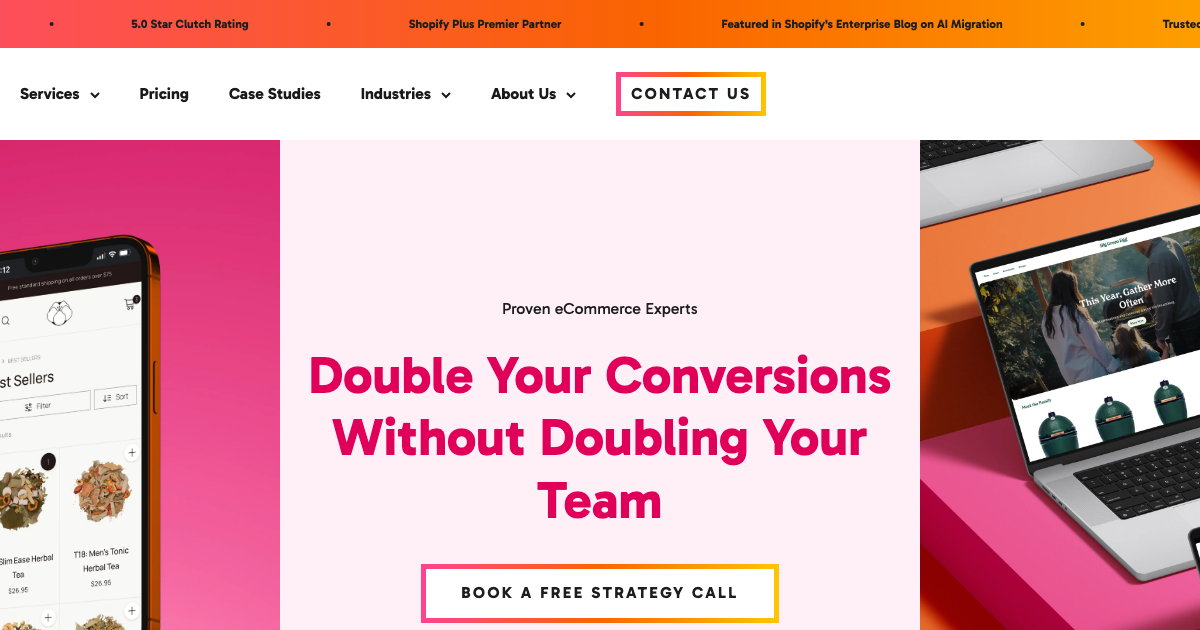
Netalico Commerce is a Shopify Plus Premier Partner founded in 2013 that has worked exclusively on Shopify since launch, pairing SEO with in-house development. Premier is the highest tier represented on this list, and only around 42 partners worldwide hold it.
Development capacity is the differentiator. Shopify’s highest-impact fixes require theme or backend changes, and consultants without developers identify problems they cannot resolve, which pushes the merchant into sourcing a second supplier. Netalico Commerce reports more than 100 Shopify Plus projects, over 300 stores launched, and 58% average first-year organic traffic growth, with Oatly, Feetures, and Big Green Egg among named clients.
Netalico Commerce scores 23 of 30. The trade-off against entries two and three is direct access: a mid-sized team with in-house developers offers more capacity and less certainty that the person on the sales call is the person doing the work.
| Year founded | 2013 |
| Team size | Mid-sized, in-house |
| Shopify Partner status | Shopify Plus Premier Partner |
| Engagement models | Retainer, project, development |
| Typical rate | $3,000 to $10,000+ per month |
| Notable clients | Oatly, Feetures, Big Green Egg |
| Office locations | United States |
| Score | 23 / 30 |
| Best for | Plus stores needing fixes implemented rather than recommended |
5. Charle Agency

Charle Agency is a Shopify and Shopify Plus specialist based in the United Kingdom, working across conventional search and AI search visibility. The agency argues that an SEO strategy built for WordPress does not transfer to Shopify, which is correct and less commonly stated than it deserves to be.
Platform reasoning drives the offer. Charle Agency works on how Shopify outputs structured data, how Liquid templating shapes content architecture, which applications obstruct discoverability, and how collections earn relevance. The agency reports ranking first for “ai seo agency for shopify”, which is a checkable claim rather than an internal metric.
Charle Agency scores 21 of 30, losing points on transparency since it publishes no rate bands and no client-attributable revenue figures. UK and European merchants gain the most from the time-zone overlap.
| Year founded | Not disclosed |
| Team size | Small to mid-sized |
| Shopify Partner status | Shopify and Shopify Plus specialist |
| Engagement models | Retainer, project |
| Typical rate | On request |
| Notable clients | Not disclosed |
| Office locations | United Kingdom |
| Score | 21 / 30 |
| Best for | UK and EU Shopify merchants wanting platform-exclusive work |
6. Shero Commerce
Shero Commerce is a women-led Shopify Premier Partner working with fashion, lifestyle, and mission-driven direct-to-consumer brands. Premier status places Shero Commerce alongside Netalico Commerce at the highest tier on this list.
Conversion work runs alongside search work rather than after it, which reads organic performance more completely than traffic growth alone. The Archer Roose engagement produced a 52% conversion rate improvement achieved alongside the SEO programme. Shero Commerce holds a 4.9 rating on Clutch.
Shero Commerce scores 20 of 30. Selective client intake slows onboarding and improves alignment once an engagement begins, and the category focus means merchants outside fashion and lifestyle find the vertical knowledge less transferable than the partner tier suggests.
| Year founded | Not disclosed |
| Team size | Boutique |
| Shopify Partner status | Shopify Premier Partner |
| Engagement models | Retainer, project, development |
| Typical rate | $2,500 to $8,000+ per month |
| Notable clients | Archer Roose |
| Office locations | United States |
| Score | 20 / 30 |
| Best for | Fashion, lifestyle, and mission-driven Shopify brands |
7. Embarque
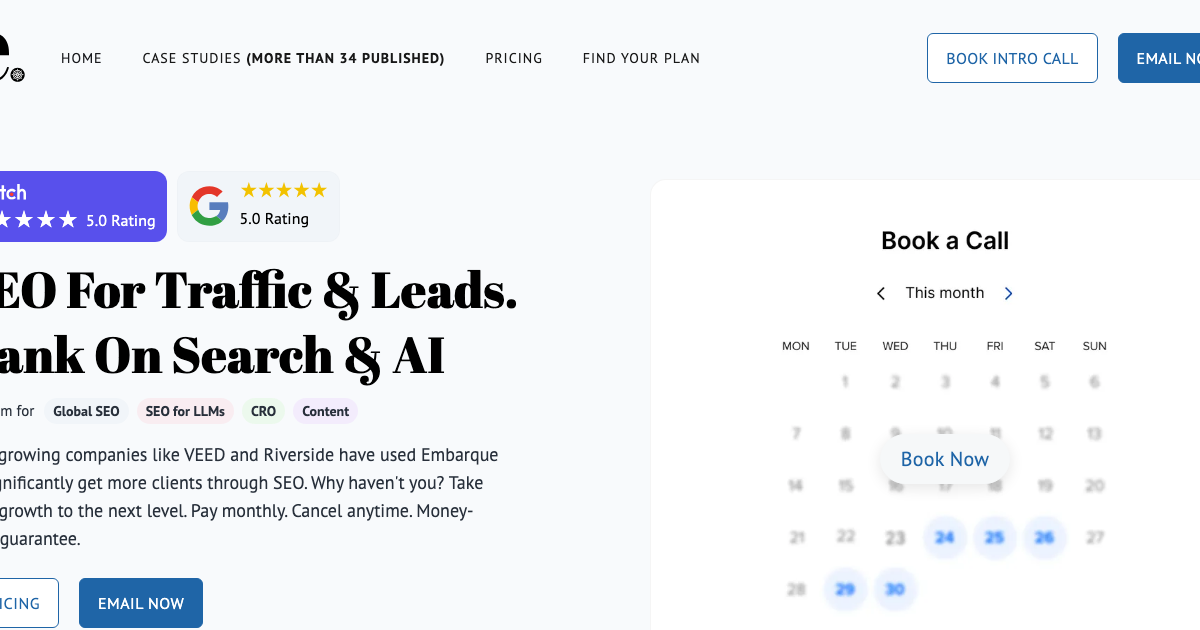
Embarque is a small London team founded in 2020 that treats organic search as a revenue channel rather than a traffic channel. Content and link acquisition form the service core, with vanity metrics explicitly rejected in the reporting model.
One published case study reports a 4x increase in organic traffic within roughly five months, driven by structured content routed to high-intent pages. That result came from a Shopify app rather than a Shopify store, a distinction worth stating because app SEO and storefront SEO share methods but not constraints. Embarque holds a 5.0 rating on G2.
Embarque scores 19 of 30. Merchants with sound technical foundations gain the most, and stores carrying collection architecture problems, schema gaps, or migration debt benefit from confirming store-side technical capability before signing.
| Year founded | 2020 |
| Team size | Small |
| Shopify Partner status | Not published |
| Engagement models | Retainer, content projects |
| Typical rate | On request |
| Notable clients | Not disclosed |
| Office locations | London, United Kingdom |
| Score | 19 / 30 |
| Best for | Stores with solid technical bases needing content and authority |
8. Aureate Labs

Aureate Labs is a Shopify development and SEO team that has worked on more than 350 ecommerce stores across ten countries. Technical breadth spans store builds, migrations, theme customisation, and headless commerce implementations.
Headless changes the requirement fundamentally. Rendering moves out of Shopify’s managed pipeline into a custom front end, which shifts responsibility for crawlability, metadata output, and Core Web Vitals onto the build itself. Conventional SEO consultants produce recommendations they cannot reach the code to implement, and Aureate Labs reports a 95% client retention rate on engagements where that access matters.
Aureate Labs scores 18 of 30. Delivery from India brings rates well below the North American band, and time-zone overlap is the trade-off a merchant accepts in exchange.
| Year founded | Not disclosed |
| Team size | Mid-sized |
| Shopify Partner status | Not published |
| Engagement models | Project, retainer, development |
| Typical rate | On request |
| Notable clients | Not disclosed |
| Office locations | India, delivering across 10 countries |
| Score | 18 / 30 |
| Best for | Headless and custom Shopify builds needing engineering access |
9. Novos
Novos is a London agency working exclusively on ecommerce organic growth, with campaigns built around creative digital public relations. Ecommerce-only discipline removes the resource split that generalist agencies carry between retail and non-retail accounts.
Digital PR is the core method. Editorial links earned from lifestyle and retail publications build the domain authority an independent Shopify store needs to outrank established marketplaces on category terms, and campaigns run on newsworthy angles rather than outreach volume. International storefront work extends the same approach into new markets where local authority has to be built rather than inherited.
Novos scores 17 of 30. Stores whose ceiling is architecture rather than authority gain more from resolving the technical layer first, since links amplify a site that already ranks and do little for one search engines cannot crawl properly.
| Year founded | Not disclosed |
| Team size | Small to mid-sized |
| Shopify Partner status | Not published |
| Engagement models | Retainer, campaign |
| Typical rate | On request |
| Notable clients | Not disclosed |
| Office locations | London, United Kingdom |
| Score | 17 / 30 |
| Best for | Independent brands whose ceiling is authority, not architecture |
10. Loopex Digital
Loopex Digital is the most accessible entry on this list by price, with Clutch-verified rates between $25 and $49 per hour. That sits well below the $71.59 average freelancer rate recorded in the Ahrefs 2026 survey, which is worth understanding before assuming it is a bargain.
Content-led SEO forms the approach, which suits stores where on-page fundamentals and blog strategy carry the highest leverage per pound spent. The Lilac St. engagement grew a beauty brand from 2,500 to 57,000 monthly organic visits, a 22x increase driven by content strategy. Loopex Digital holds a 4.9 rating on Clutch.
Loopex Digital scores 16 of 30. Complex technical work including faceted navigation control, crawl budget management, and advanced schema needs supplementation as the catalogue grows, and results of that shape happen most readily on stores starting from a low baseline.
| Year founded | Not disclosed |
| Team size | Small |
| Shopify Partner status | Not published |
| Engagement models | Retainer, hourly |
| Typical rate | $25 to $49 per hour, $1,000 to $3,000 per month |
| Notable clients | Lilac St. |
| Office locations | Not disclosed |
| Score | 16 / 30 |
| Best for | Early-stage Shopify stores under $500,000 in revenue |
Should you hire a freelancer, consultant, agency, or in-house?
Revenue stage decides the answer more reliably than preference does, with freelancers suiting stores below roughly $100,000 monthly revenue and agencies suiting stores above $300,000. Bringing the work in-house becomes viable much later than most merchants assume.
The table below compares the four routes on cost, coverage, and the risk each one carries.
| Route | Typical cost | Covers | Main risk | Best for |
|---|---|---|---|---|
| Freelancer | $71.59 per hour average | One workstream well | Single point of failure | Under $100K monthly revenue |
| Consultant | $171.18 per hour average | Strategy and diagnosis | You implement, or nobody does | Stores with internal capacity |
| Agency | $98.90 per hour, $3,209 average retainer | Technical, content, links | The pitch team is rarely the delivery team | Over $300K monthly revenue |
| In-house | $90,000 to $160,000 salary plus benefits | Deep category knowledge | One person cannot cover every discipline | Past $20M annual revenue |
When does a freelancer win?
A freelancer wins on defined scope where the store’s foundations are sound. Skyloom Studios places the threshold at under $100,000 monthly revenue, and shopexperts puts senior freelancers as the best fit for stores between $500,000 and $5 million annually.
Direct communication with the person doing the work is the structural advantage, and the Ahrefs average of $71.59 per hour means the same budget buys substantially more hours than agency or consultant rates do.
When does a consultant win?
A consultant wins where the store has internal capacity to implement. Skyloom Studios prices independent consultant retainers at $2,000 to $5,000 per month plus internal team time, and names the risk plainly: most independent consultants do strategy and hand off implementation.
The arrangement fails without an internal owner who executes the recommendations, which is harder to find than it sounds. A consultant’s diagnosis sitting unimplemented in a shared drive costs the same as one that shipped.
When does an agency win?
An agency wins where several disciplines move at once. Skyloom Studios places the crossover at $300,000 monthly revenue, and shopexperts at $3 million annually with Shopify Plus complexity.
Capacity absorbs absence, which the individual models cannot. The trade-off is that agency quality varies widely and the account manager on the sales call is rarely the person doing the work, which makes vetting matter more at this tier than any other.
When does in-house become viable?
In-house becomes viable past roughly $20 million in annual revenue, according to shopexperts, where a content engine needs full-time management or SEO sits inside product decisions. Senior SEO salaries run $90,000 to $160,000 plus benefits.
Below that threshold the economics rarely work. One internal person typically covers less ground than a small specialist team bringing combined experience across many stores, and the role usually gets absorbed into a broader marketing job where specialist depth suffers.
Got a quote and want to know what it buys?
Book a free 30-minute call and bring the proposal. We will convert the fee into hours at market rates, check the tier and Verified Skills claim against the Partner Directory, and tell you whether the scope matches the price. Bring more than one quote if you have them.
Get a quote pressure-tested →
What does a Shopify SEO expert cost?
Shopify SEO costs between $25 and $200 per hour and $1,000 to $15,000 per month, with provider type driving more of the variation than quality does. The word “expert” itself carries no price band.
What are the hourly rates by provider type?
The Ahrefs 2026 survey of 439 SEO professionals gives the cleanest read on the market: freelancers average $71.59 per hour, agencies $98.90, and consultants $171.18. Backlinko’s survey of more than 300 professionals adds the experience bands, with entry-level specialists at $50 or less, the majority between $100 and $150, and expert-level specialists at $151 to $200 or more.
Shopify-specific figures sit inside those ranges. Lucent Innovation places agency service fees at $80 to $200 per hour across the US and Europe, with freelancers at $40 to $130 on platforms like Upwork. Folio3 notes the geographic spread directly: North American specialists charge $50 to $150 per hour against $15 to $45 for developers in Asia.
One finding from the Ahrefs data deserves particular attention when vetting. Moving from two years in business to more than ten adds only about $45 per hour, rising from $73.05 to $118.35. Tenure barely moves price, which means years in business is a weak signal and Shopify-specific documented results is a strong one.
What do monthly retainers cost?
Retainers are the dominant model, used by 78.2% of providers according to Ahrefs. The table below sets out the averages by provider type alongside the distribution, which matters more than the average.
| Metric | Figure | Source |
|---|---|---|
| Average retainer, all provider types | $2,917 per month | Ahrefs 2026 |
| Average agency retainer | $3,209 per month | Ahrefs 2026 |
| Average freelancer retainer | $1,348 per month | Ahrefs 2026 |
| Freelancer versus agency gap | 58% lower | Ahrefs 2026 |
| Agencies charging $1,500 to $5,000 | Roughly 48% | Ahrefs 2026 |
| Agencies charging under $1,500 | Roughly 43% | Ahrefs 2026 |
| Agencies charging over $5,000 | Roughly 5% | Ahrefs 2026 |
| Shopify SEO engagements | $1,500 to $15,000+ per month | shopexperts |
What does each budget actually buy?
Rates convert to hours, and hours convert to scope. The table below reverse-engineers what each monthly budget buys at the Ahrefs freelancer and consultant averages, which is the calculation most quotes leave the merchant to do alone.
| Monthly spend | Hours at $71.59 | Hours at $171.18 | Realistic scope |
|---|---|---|---|
| $500 | 7 | 3 | Reporting only, or junior work against a checklist |
| $1,000 | 14 | 6 | One focused workstream, no strategy |
| $2,000 | 28 | 12 | Technical fixes or content, not both |
| $3,000 | 42 | 18 | Two workstreams with light strategy |
| $5,000 | 70 | 29 | Technical, content, and reporting with an owner |
| $10,000 | 140 | 58 | Full programme including links and conversion input |
Skyloom Studios reaches the same conclusion at the bottom of the range independently, noting that $500 to $1,200 per month buys three to six hours of junior execution, producing keyword spreadsheets and status reports rather than compounding results.
Why do the pricing surveys disagree?
Three 2026 surveys asked providers the same question and disagree by more than three times. Ahrefs puts the average agency retainer at $3,209 per month. SE Ranking found 64% of agencies charge under $1,000. Clutch reports an average monthly cost of $3,199 and an average project cost of $37,158.
Sample composition explains most of the gap. Surveys reaching local-business SEOs report far lower numbers than surveys reaching ecommerce and business-to-business providers, and Clutch’s project average is pulled upward by a small number of enterprise engagements while most projects land under $10,000.
The practical takeaway is to treat any single average as a starting point rather than a benchmark, and to compare quotes on deliverables and hours rather than on headline price.
Which engagement model fits the work?
Rate is one variable and structure is the other. Three models dominate Shopify SEO, and the right one depends on whether the problem is bounded or ongoing.
| Model | Typical range | Fits | Fails when |
|---|---|---|---|
| Hourly | $25 to $200 per hour | Second opinions, troubleshooting, strategy calls | Scope creeps and hours become unpredictable |
| Project | $500 to $20,000+ | Audits, migrations, one-time optimisation | Ongoing work gets billed as repeated projects |
| Monthly retainer | $1,000 to $15,000 per month | Compounding technical, content, and authority work | Deliverables stay vague and hours go unreported |
Retainers dominate the market, used by 78.2% of providers according to Ahrefs, and they are also where the least transparency sits. A retainer quoted without an hours figure gives the merchant no way to judge whether the price is fair, which is why the hours question belongs in every first conversation.
One-time work has its own bands. A comprehensive audit from a reputable supplier runs $5,000 to $10,000, while standalone link or content audits fall between $500 and $7,500. Clutch reports an average project cost of $37,158, though that figure is pulled upward by enterprise engagements and most projects land under $10,000.
Where do you find a Shopify SEO expert?
Four channels supply Shopify SEO experts, and they differ in vetting rigour rather than in price. The Partner Directory is the only one where Shopify itself has verified anything.
The table below compares the four on what vetting each applies before a name reaches the merchant.
| Channel | Vetting applied | Strength | Limitation |
|---|---|---|---|
| Shopify Partner Directory | Tier requirements, Verified Skills, reviews tied to real engagements | The only Shopify-verified source | Excludes Registered partners entirely |
| Freelance marketplaces | Platform ratings and job history | Fast, price-transparent | Ratings reflect delivery, not Shopify depth |
| Editorial rankings | Whatever the publisher chooses to disclose | Comparative context | Usually published by an agency that appears in them |
| Referrals and communities | None, beyond the referrer’s experience | Highest signal per name | Small sample, and no pricing comparison |
Combining two channels works better than trusting one. Filtering the Partner Directory by tier produces a verified shortlist, and cross-checking those names against published case studies and independent reviews tests whether the tier reflects SEO capability or development volume.
How do you vet a Shopify SEO expert?
Vetting a Shopify SEO expert means checking platform credentials against the Partner Directory, then testing platform knowledge with questions a generalist cannot answer specifically. Confidence is not evidence.
Which twelve questions should you ask?
The questions below separate Shopify specialists from generalists listing Shopify as a capability. Each one has a weak answer and a strong answer, set out in the table.
| Question | Weak answer | Strong answer |
|---|---|---|
| Which Partner tier do you hold? | “We’re a Shopify Expert” | Names a tier and sends the directory link |
| Which Verified Skills are on your profile? | Deflects to certifications | Names specific skills |
| How do you handle duplicate URLs between /collections/ and /products/? | General duplicate content advice | Names canonical consolidation to the product slug |
| Which Liquid files do you edit? | Does not mention Liquid | Names theme.liquid and the product template |
| Do you implement, or hand off recommendations? | “We advise, your developer implements” | States implementation route clearly either way |
| What percentage of your clients are on Shopify? | “We work with lots of platforms” | Gives a number above 50% |
| Can you show a collection page you optimised? | Shows a blog post | Shows a collection with intent-matched copy |
| What happens when you are unavailable? | No answer | Names cover or states the limitation plainly |
| How many hours does the retainer buy? | Refuses to quantify | Gives an hours range against the fee |
| What does month one deliver? | “We’ll figure out priorities” | Names an audit and a prioritised fix list |
| How do you report on organic revenue? | Shows a rank tracker | Describes GA4 attribution by landing page |
| What is your position on AI search? | No position | Names crawler access and structured data work |
What does a strong answer sound like?
Specificity is the signal, not confidence. A specialist answers the duplicate URL question in one sentence and names the path structure without prompting, because the problem appears on every Shopify store they have touched. A generalist answers correctly in general terms and never says /collections/ or /products/.
The same test applies to the Liquid question. An expert who never mentions Liquid files has not worked inside a Shopify codebase, regardless of how many Shopify clients appear on the website.
Which red flags disqualify a candidate?
The warning signs below appear consistently in merchant complaints about failed Shopify SEO engagements.
- Guaranteed rankings: nobody controls Google’s algorithm.
- “Shopify Expert” claimed with no tier: the designation was retired in October 2023.
- No Partner Directory profile: indicates Registered tier or no partnership at all.
- Strategy only, with no implementation route: the recommendations sit unshipped.
- Rates far below $71.59 per hour: the Ahrefs freelancer average, and quotes well under it buy junior time.
- No named Shopify clients: testimonials without stores are unverifiable.
- Twelve-month lock-ins with no break clause: all risk sits with the merchant.
- No position on AI search: a 2022 brief sold into a 2026 channel mix.
How do you write a brief for a Shopify SEO expert?
A brief for a Shopify SEO expert states the current organic baseline, the specific problem, catalogue and market scope, the budget band, who implements, and how success is measured. Six elements, roughly one page.
The elements below turn a vague enquiry into comparable quotes.
- Current baseline: organic sessions, organic revenue, and the share that is branded.
- The specific problem: flat non-branded traffic, a post-migration decline, or thin collection visibility.
- Scope: product count, collection count, and how many markets the store sells into.
- Budget band: a range rather than a figure, so candidates scope honestly instead of guessing.
- Who implements: internal developer, the supplier, or nobody yet.
- Success definition: the metric that decides renewal at month six.
Timeline deserves realistic planning. shopexperts recommends allowing four to six weeks from the start of the search to a signed contract, covering scope definition, candidate identification, calls, and reference checks.
What should the first 90 days look like?
The table below sets out a defensible first-quarter sequence and the signal that confirms each phase worked. A supplier unable to describe something similar has no process.
| Phase | Weeks | Deliverable | How you know it worked |
|---|---|---|---|
| Audit and baseline | 1 to 3 | Prioritised findings with affected URLs | Findings carry impact scores, not just counts |
| Technical fixes | 3 to 6 | Canonical, indexation, and speed work shipped | Search Console coverage improves |
| On-page work | 5 to 10 | Collection and product page rewrites | Target collections start appearing in queries |
| Content and authority | 8 to 12 | Buyer-intent content, first link placements | Non-brand impressions rise |
| Review | 12 to 13 | Reporting against the month-one baseline | Organic revenue is reported, not just sessions |
How long does Shopify SEO take to work?
Most Shopify stores see measurable results within three to six months, while new stores and competitive niches take nine to twelve. Compounding continues well past the first year.
Shopify’s own SEO Lead places the standard window at three to six months for measurable movement. Shopify’s return-on-investment guidance puts break-even at around nine months with returns compounding to five times or more by year three, and analysis published by First Page Sage across 80 ecommerce clients reports a 317% return with a comparable break-even window.
Technical fixes move fastest, showing measurable change within four to eight weeks because Shopify is good for SEO optimizations in general. Content and authority work takes six to twelve months to reach revenue. Any supplier promising page-one rankings within 30 days is describing something other than SEO.
Frequently asked questions
Eight questions follow the hiring process closely enough to answer directly. Fuller reasoning on rates, vetting, and the Partner Directory sits in the sections above.
What is the difference between a Shopify SEO expert and a consultant?
A Shopify SEO consultant is a defined role that diagnoses and directs at an average of $171.18 per hour, while “expert” is a marketing word with no pricing category or formal status behind it. The Ahrefs 2026 survey of 439 professionals prices consultants at roughly 2.4 times freelancers.
Is “Shopify Expert” an official Shopify title?
“Shopify Expert” is not an official title, because Shopify replaced the Experts Marketplace with the Partner Directory in October 2023 and sunset the Plus Partner Agency Program brand in December 2024. The current equivalent is a Partner with Verified Skills at Select tier or above.
How much does a Shopify SEO consultant charge per hour?
A Shopify SEO consultant charges $171.18 per hour on average, against $98.90 for agencies and $71.59 for freelancers, according to the Ahrefs 2026 pricing survey. Specialised enterprise consultants reach $250 to $400, and Shopify-specific freelance rates run $30 to $150.
Can one person handle technical, content, and link building?
One person rarely handles technical, content, and link building well simultaneously, because the three are separate specialisms competing for the same hours. A solo supplier covering all three is usually strong at one and adequate at the others, which is worth establishing before signing.
Does a Shopify SEO consultant implement changes or only advise?
Most independent Shopify SEO consultants advise rather than implement, handing recommendations to the merchant’s developer. The arrangement fails without an internal owner who executes, so establish the implementation route before agreeing scope rather than after the first report arrives.
What happens when a solo consultant is unavailable?
Work stops when a solo consultant is ill, on holiday, or at capacity, because no cover exists. Single point of failure is the structural cost of direct practitioner access, and a supplier who names it openly is more trustworthy than one who avoids the question.
How do you check whether a Shopify SEO expert is actually vetted?
You check a Shopify SEO expert by searching the Shopify Partner Directory for their profile, since roughly 1,012 partners out of more than 700,000 rank above Registered and Registered partners do not appear at all. No profile means no tier and you want to double check if they are skilled in AI SEO for Shopify to be future-proofed.
Is a cheap Shopify SEO expert ever worth it?
A cheap Shopify SEO expert is worth it for defined, bounded work such as a metadata rewrite or a content batch, and rarely worth it for a full programme. Rates below the $71.59 freelancer average buy junior hours, and $500 to $1,200 per month buys three to six hours of execution.
Space'M Online
The Shopify SEO audit checklist
Every check on this page in one document: duplicate URL consolidation, faceted navigation control, app-bloat thresholds, theme file locations, and hreflang validation for multi-market stores.
Book an intro call